B&E Blog pic

B&E Blog pic
Happy Travelers!

Itinerary

Itinerary
2015 World Cruise itinerary

Tuesday, April 7, 2015

We have just finished three days in Cape Town and three days is definitely not enough. Cape Town was a revelation. It is easy to see why so many of our friends who have visited here have told us that it is a great place to visit. Granted that our three days consisted of a Hop On Hop Off (HOHO) bus ride to get a feel for the city itself, a day spent exploring the Cape peninsula, and a day in the wine areas of Stellenbosch and Franschhoek. We did not have a lot of time to wander the city itself; however, we understand that it pretty safe - taking the usual precautions and staying out of the dicey areas.


Our first day was like taking a bite of some new, exotic food and wanting more, but they had already run out of it and you have to wait a while for seconds… Cape Town is definitely a place we want to return to, but it’s a long way from Florida and when we do return, if not by cruise ship, it will be for a more extended stay.
 
On arrival it was pretty cloudy and overcast. You could not see the top of Table Mountain. It was covered by the "tablecloth."

This is what we had for the next two days!

I couldn't resist this rainbow . It appeared immediately after a short misty rain shower.

Do not get the idea that Cape Town is like a European city. It is definitely a place that warrants more time, but it is also a place that is struggling to maintain its gains over the past two decades and to move forward from a less-than-optimal past. The shadow of Apartheid still hangs over some areas and one cannot ignore the several million people still living in “townships” just beyond the city core. A sense of awareness and caution accompanies any foray into the city as one would in any new environment.

OK that said, our first day was relatively easy. We and another couple that we had become friendly with on the ship opted for the HOHO as an easy way to become familiar with the city and spot likely places to return for further investigation. We have found that using a HOHO in a new city (where they have them) is a great way to get familiar in a hurry. The HOHO in Cape Town wound through the downtown area and out to some of the more touristy beaches just outside of town. We were awed by the beauty of the countryside and the ruggedness of Table Mountain.

Table Mountain is everywhere you look in Cape Town – except of course out to sea. The city is lodged in a “bowl” at the foot of the mountain and it seems that everything revolves around whether the mountain is “out” or not – similar to Mt. Rainer in Washington outside of Seattle. Table Mountain is often shrouded in clouds, fog and mist. These days, especially if there is a wind – and there is almost always some wind – the cable car does not run and you can only get about halfway up to the lower cable car station. In the morning when we started our journey, it was overcast and cloudy. The cable car was not running, but the HOHO still went up to the viewing station and the views were spectacular. We can only imagine what it must be like from the top of the mountain. We also found that the individual cable cars rotate 360° as they rise or fall so you get a sweeping panoramic view of everything. We really want to return, if only to experience that ride!
 
A view of Robben Island from the V & A Waterfront. It is about 6 miles offshore.

View from the lower cable car station during our HOHO tour.

View of Clifton Beaches.

Another neat location right downtown on the waterfront is the V &A Harbor Development. This is the Victoria and Alfred Mall, Museums, Aquarium, and other exhibits. Yes, another monument to the virgin queen, but not to her consort, but her son, Alfred (not Albert). The son visited Cape Town as a young naval officer and thought so much of it that he spent significant time here. The developers named the project after him to honor that early commitment. The V & A consists of a multitude of shops, high-end and for us regular folks, restaurants, including as branch of Nobu, the iconic Japanese restaurant, and even more construction and historic landmarks. You could easily spend a day or two exploring the place.

After our HOHO tour, which lasted about two hours, we opted for a light lunch downtown; however, it was Saturday of Easter weekend and a lot of places were closed. We would up in an Irish pub just off the main street and had a remarkably good fish and chips lunch, complete with adult beverages for an astonishingly low price. Yes, we do like Cape Town… After lunch our friends went back to the ship and we decided to explore and possibly engage in a little retail therapy. Nothing really came of that except that we saw a lot of handmade craft items and after a while everything began to look alike.

The second day we had a semi-private tour of the Cape Peninsula. I say “semi-private” because we had contracted with a tour company that uses eight passenger minivans and we would up with ourselves and five others. They were all oil company geologists and technicians who were working in Angola for an Italian company, so three of them were Italian and it made for an interesting and fun group.


We left the city and headed south toward Table Mountain National Park. This park encompasses the entirety of the southern cape peninsula. Along the way we stopped for a photo op at Clifton Beach and another at Hout Bay Marina. The wind at Clifton was fierce! The beaches are beautiful, but the wind makes it interesting to enjoy them. Our driver/guide, Ebrahim, told us that the water is so cold that you go in as a man and come out as a boy…
 
Clifton Beaches. Notice the tree on the right and how the wind has shaped it.
The scenery is spectacular everywhere we go. We have had four stops in South Africa and this is one of the most in-depth, but everywhere we have been we have commented on how beautiful the country is. If they can overcome their social issues, they will, I believe, become the next big thing in tourist meccas.

At Hout Bay we had an opportunity to take a short boat ride to see the fur seals on an island in the bay, but we declined because we were all anxious to get to the point before the crowds – this is Easter Sunday! As we drove down the highway and through the mountains, we went via the scenic Chapman’s Peak drive. This is a winding highway that lays in among the rocks and crevices that form the western shoreline of the peninsula. Unfortunately, we could not stop for pictures at some of the more interesting underpass and roadway supporting structures. As a Transportation Engineer, I marveled at how they built this road. The following three pictures are views from the lookout on Chapman's Peak drive.


As we approached the park entrance, we saw that the line was already beginning to back up. It took us almost a half-hour to creep up to the toll gate. Once in, however, it was fairly smooth driving to get to the point. We made our first stop at the Cape Point Lighthouse. We could drive up to within about a half-mile of the base of the lighthouse and then take the funicular railway up to the base of the lighthouse itself. From there, we had to climb 120 steps (I counted them) to get to the lighthouse and the lookout. From the lighthouse one can see both the Indian Ocean and the Atlantic Ocean. The two oceans do not meet at this point, but at a point further east called Cape Agulhas. Cape Point and the Cape Peninsula are actually surrounded by the Atlantic Ocean. False Bay on the east side of the cape point is so named because early mariners coming from India and China thought that as they rounded that point, they were headed north only to founder on the rocks and often perish.
 
View from the lighthouse down to the upper funicular station.


Mile marker at the lighthouse.

View from the bottom of the 120 steps to the lighthouse.

After the lighthouse, we worked our way further west to the Cape of Good Hope, the southwesterly-most point on the African continent. We thought Clifton Beach was windy – HA! The wind on this little spit of rocky land seemed like it would cut you in half – and this is only the end of summer beginning of autumn down here. I can’t imagine what it must be like in winter.


As we were leaving the park to go to lunch, we saw that the entry queue had lengthened to over a mile and traffic was spilled out from the park entrance road onto the main highway for over a quarter-mile. Later in the day we saw some folks back on the ship that had been in that line and they never got to get in! They waited in line for over an hour and when their driver told them it might be another hour, they bagged it and found other sights to see in the area.

After lunch in Simonstown on the eastern shore of the peninsula, we went to the Boulders Penguin Reserve. This is a protected park area for the African Penguin. An interesting species, this little gentleman. Their call sounds exactly like a donkey braying. They used to be called Jackass Penguins, but the PC Police have apparently found their way to South Africa and they were renamed. Actually, there are several species of penguins that have this distinctive braying call, so the ones that are found here were renamed the African Penguin as a way of identifying their habitat. Whatever you want to call them they are too cute for words. We were fortunate to see several as they were in various stages of molting. Several others had chicks that were being fed and weaned by the mothers, but most of them were just being penguins.

We made a final stop at the Steenberg Winery, but by that time it was almost six in the evening and we were wiped. So we made it short and headed back to the ship to rest up for our next day of real wine tasting.

The third and last day in Cape Town we had a tour of some of the cape’s famous wine farms (we would call them vineyards in the U.S. but here the vineyard is part of the farm, so the whole thing is called a wine farm). We began in Stellenbosch and would up in Franschhoek. Our companions this day were a young couple from Brazil – very nice, very accommodating, and very much in love… We knew it would be another good time.


Our first stop was at Ernie Els Winery – yes, that’s Ernie Els, the Golf Pro. We discovered that he is making some very good juice as well. Actually, it’s his winemaker, but we believe he would not put his name on anything that is not good quality. As an aside, because of some family issues with his son, Ben, he has founded the Els Autism Center in West Palm Beach and moved there to help his family and others that may be in need of these services. We did not discover this until we were back on the ship and read the small pamphlet that was included in the six-pack we bought to bring back with us. here are some views at Ernie Els Winery:


The other two wineries that we visited were Waterford Wine Estate in Stellenbosch and La Motte Winery in Franschhoek. They had some nice wines, but nothing that we just had to have – especially when we found out that both could be obtained in the states.

Our lunch stop was in Franschhoek, a smaller winery area, but very nice. We ate at a sidewalk cafĂ© and again were impressed with the quality and quantity of food for such low prices. In general we were very impressed with all of the wine country we saw. The scenery is too magnificent for mere words. The wine farms are so well kept and the tasting rooms – at least the ones we saw and entered – put most of what we have seen in California to shame. They have spent a lot of money on these tasting venues at the farms in the belief that to sell their wine, people must come and taste. It works!
On the way back from Franschhoek, we made a short stop to see the prison at Groot Drakenstein where Nelson Mandela spent the final year of his confinement. Actually, we saw three prisons during our stay in Cape Town: Robben Island; the prison in Cape Town where he lived for nine years, whose name now escapes me, where he was transferred after 17 years on Robben Island; Groot Drakenstein. We did not make it to Robben Island, but that is a destination for the next time we are in Cape Town.

Back to the ship in time to watch us sail out of Cape Town Harbor and run the pictures of our tours and walks through our mind as we left… We now begin the final leg of our around the world cruise: Cape Town to Fort Lauderdale. Stay tuned for some final updates and the next post in this blog will have a map and other info about that leg.


Friday, April 3, 2015

East London is our next-to-last stop in South Africa and is only a half-day stop in the afternoon. We believe it has been put on the schedule to accommodate our landing in Cape Town. We have to be there at a specific time and need to do something between Durban and Cape Town. There is really nothing much to say about East London except that it is home to one of Mercedes-Benz’s largest assembly plants. They assemble a lot of C-class cars out of here each year.


Our visit was a choice of either touring the town –oops, we blinked and missed half of it… - or going to a private game reserve. We opted for the reserve because it would be the last chance we would have to see large animals and would also give us a chance to see some of the South African countryside that we had not seen before.

Our visit to the Inkwenkwezi (ink-wenk-way-zee) Game Reserve was different from both our earlier Kenyan safari and our Hluhluwe-Imfolozi state-owned reserve visit earlier in the week. Inkwenkwezi is an area of about 4000-5000 hectares (about 10,000-12,500 acres) that was put together by two brothers about 20 years ago and has been in operation for almost as long. They are able to buy animals from the government when the government does annual culling or has an excess of any particular species that they want to keep, but relocate.

The current herd numbers several hundred impala, water buck, giraffe, ostrich, kudu, zebra, nyala (a type of antelope) wart hogs, rhinos, elephants, and lions. The lions are kept in a separate part of the reserve from the other animals and will be released into the main part when the overall herd grows to the point that the natural hunt-kill cycle of the lions feeding does not decimate the herd. We were told that the lions can kill as many as 500 animals a year, so they will need a few more years until they can combine the two types of species – preyer and preyee.

The natural vegetation is also quite different from that in Kenya and the more eastern part of South Africa that we saw in Hluhluwe-Imfoloz. It is wilder, that is, with more scrub and hills. Again, I can best illustrate our tour with a few pictures.
 
The elephants at upper left seemed not to mind each other, then suddenly one raised his trunk and the other one got into it with him. The bottom two pictures are of some of the herds of impala, kudu, zebra, and giraffe that we saw.
The highlight of this game drive was our visit to the lions. We were put through a sally port (a dual gate set up that only allows one gate at a time to be opened) and entered the lion reserve directly. The lions were most cooperative and lined up for photos and a few growls. It was really neat to be only about 30-50 feet from full grown lions, and a couple of really adorable cubs. I think that the females were a little squirrelly because we were so close to the cubs.
 
Upper left and inset are the two cubs - one white and one natural tawny. The mother on the lower right was a little nervous at our proximity.
We were in Land Rovers so we could get quite close to the lions. The vehicles do not bother them since they do not see the machines as a threat. People on the ground walking around are, however, definitely perceived as a threat. After we drove back through the sally port and dismounted from the vehicles, we could walk up to the fence (a chicken wire fence!!) and get to about within 10’ of the fence before the lions on the other side of the fence and only about 50’ away assumed an aggressive position. Cool!
 
This guy was in no mood to mess with interlopers. He has flattened his mane, brought up his rear legs, pinned back his ears, let out a low rumbling growl, raised his head just enough to see us over the grass. He wants us out of there - or else!
Our next stop is in Cape Town where we have two private tours scheduled and a day at leisure.


Stay tuned…

Wednesday, April 1, 2015

We are in South Africa and we will have four ports to visit. The first port is Richards Bay in the northeastern part of the country. We had a terrific day at a state-owned game reserve, the Hluhluwe-Imfolozi Game reserve. Try saying that three times very quickly. Here is a key to pronunciation. In Xhosa, the local native language, the “H” is pronounced as an “SH” and the “I” in the second word is pronounced like a short “U” as in “Um.” Therefore, the whole name is pronounced “shlu-SHLU-wee um-foe-LO-zee.” See how easy that was???

Without getting into the logistics of getting to and from the game reserve and detailing the jeep rides and South African cuisine picnic lunch, I will let some of the pictures do the talking for this leg of the trip.

After the game reserve, we went to the much more easily remembered, and pronounced, St. Lucia Wetlands Reserve to mingle with the hippos and crocodiles.

Here are the pictures with some captions to give you an idea of what we saw.

The two bulls that are highlighted by arrows were fighting for herd leadership. It was interesting to watch and I apologize for not getting better pictures of them going at it, but my camera is very limited in capturing action shots.

I had to include these two pictures of the smallest animal we saw: a dung beetle. She rolls a ball of animal dung into the size of a softball, lays a single egg inside and the larva eats its way out when born...

Our driver/guide had never seen a pair of baby giraffe before and told us that this sighting was extremely rare.

They were just kidding...actually, they "play fight" to help pass the time we are told. The two bottom pictures are of a baby hippo, We were told that he was just about three months old.

Beautiful landscapes.

These four pictures happened when we came on a lioness eating her kill of a Cape Buffalo. The guide told us it would have taken at least three lions to bring one of these buffalo down.

We were again very fortunate to happen upon a rhino family. The baby, bottom left and on the right in the bottom right picture, is about two months old.

We left Richards Bay late at night for a short sail down the coast to Durban, South Africa’s fourth largest city and one of the largest and busiest harbors in the world. 

Durban appears to be the antithesis of what you come to expect in Africa. After our earlier stops, Durban surprises with an ultra-modern skyline capped with high –rise office and residential buildings, a magnificent harbor that seems to be bursting with activity and energy, and almost four million people to make it all go.

Not! The static description above is all true, but the activity and energy are lacking. In fact, Durban has almost a 50% unemployment rate. It is no wonder that the Durban Visitors’ and Tourists’ Bureau contains the following warnings:


Needless to say, we did not venture into the city, but opted for a half-day excursion to the Phezulu Safari Park. The park is located in the Valley of a Thousand Hills and is reported to be spectacular scenic wise.

The drive out was uneventful and we had a nice guide to give us some background on Durban, but he only reiterated what both the ship’s travel consultant and the Durban Map had said – be careful when not in a tour bus.

The promised scenic drive and vistas of the Thousand Hills area was as advertised (although we did not count the hills, so I can’t vouch for the authenticity of that number). The views were spectacular.
The Safari Park was interesting, sort of – think Disney for Tourists… At the Safari Park, we were treated to a short program of Zulu dance and song that gave us some insight into how Zulu warriors courted, fought, and had their fortunes told. All done tastefully (translated that means fully dressed rather than authentic 1860-1920 native garb) and with a great deal of energy.


Unfortunately, the Safari Park and its ersatz Zulu encampment only underscores how difficult it is for many of the younger people and those older than about 45-50 to find work. After the dancing and singing, we were led to the crocodile pits and given a rather interesting and in-depth explanation of how crocs are a part of African life. Then followed the tortoise, turtle, and snake exhibits, a break for tea and scones before the obligatory traipse through the gift shop, and back to the bus for home.
The ride home was a little more interesting since we took a longer route through the main part of the city and got to see some of the historical buildings and the masses of people standing around and trying to look busy. There was a very pronounced police presence everywhere we looked and our guide was not shy about telling us that they make themselves very visible.

We leave Durban early this evening for East London another short hop down the coast on our way to Cape Town. Cape Town is a three-day stop, so stay tuned for news of the wine country, our Cape Point tour, and a surprise that the ship is preparing for those of us on the world cruise.


Sunday, March 29, 2015

This post will combine our stops in Mayotte, Nosy Be, and Mahajanga. Where in the world are these strange sounding places? Mayotte is in the Comoros Islands off the east coast of Africa near the Seychelles. It is the only one of the Comoros that has voted to remain French and as of last year was made a Department of France. That is like a state in the US. Nosy Be and Mahajanga are in Madagascar, another island off the east coast of Africa and literally worlds apart from anything you may imagine an island in the Indian Ocean might be.


Mayotte was a short stop and we took a bus tour of the island. We visited the botanical garden, the eroded rock dunes, called “padzas”, a giant Baobab tree, a primitive salt factory, and had a nice lunch. We determined that we had seen just about all Mayotte has to offer.

The botanical garden was small, had a few unusual specimens of indigenous trees and shrubs, and took about a half-hour to get through. The eroded rock dunes are quite unusual as they are very colorful, mostly reddish hues, and are located in an almost inaccessible part of the island. Truth be told, both Bonnie and I could not make our way up to the top and the scenic lookout.

Our lunch stop was probably the most delightful part of the day’s journey. The restaurant was so rustic that we thought we might want to bring our own glasses and silverware. Once we got over the rusticity of the place and saw the food, it was easier to relax and enjoy both the food and the views. The restaurant was on the beach – not near the beach, but ON the beach. The sand was a black sand, similar to what might be found in Hawaii and very warm to the touch. The temperature hovered around 100° all day. We were greeted by women in traditional dress with face makeup indicating their marital status. Solid color and lines for married women and flowers and intricate designs for single women. BTW, the term women is used loosely here since many girls are married around the age of 12. Mayotte is very African for being part of France…
 

Following our lunch we visited the “MuseĂ© de Sel” or Salt Museum. This is a living museum where women demonstrate the art of producing salt from seawater and mangrove silt. They scrape the ground by hand using a shell, then they sift the soil/salt mixture and rinse it with sea water. This is followed by evaporating the salt-rich rinse water in large tubs over open fires for about a day. The salt that remains is then packaged and sold locally – or to tourists…
Making salt: upper left is the "factory"; upper right is the ladies scraping the salt-rich silt; lower left is the evaporation tank; lower right is the finished product ready for packaging.
 
The finished products.
We then drove a short piece up the road to look at one of the world’s oldest trees – a very large Baobab tree. I can’t vouch for the age of the tree, but the guide was convinced that it was at least 300-400 years.

Finally, we drove back to the pier, tendered out to the waiting Silver Whisper for a shower and a rest. We had to build our strength for the next day in Nosy Be and our visit to the Lemur colony – that’s Lemur colony, not Leper colony…
Nosy Be is an island off the coast of Madagascar, which itself is an island, the fourth largest in the world after Greenland, Iceland, and Borneo (Australia doesn’t count since we consider it a continent). Madagascar is not a wealthy country. It is about the most third-world place we have visited.

We tendered in to the pier at the aptly-named Hellville. Hellville, while possibly a statement of fact, was actually named for a long-deceased French Admiral named – what else – Antoine de Hell. We immediately walked about 20 yards to our “water taxi” or shuttle boat that would take us to Nosy Komba and the Lemur colony (and miss the dubious pleasures of Hellville itself). Nosy Komba is yet another island off Nosy Be that is home to about 5000 permanent inhabitants (human) and several hundred Lemurs in a protected areas on the island.

The landing on the island was a “wet landing,” that is, there was no dock. The boat just pulled up as close to the beach as he could get and we walked off into the surf. The villagers were all out to greet us since few cruise ships stop here (about 10-15 a year, mostly Italian [Costa we were told]). Most of the greeters were children. Madagascar has one of the highest birth rates in the world – and one of the highest children’s mortality rates as well. The kids were just heartbreakers. They are so cute and so innocent – even though most were dancing and selling trinkets for money. We refrained from giving in to throwing a few coins or dollars into the baskets since that only encourages them to skip school and beg.

After wending our way through a few of the “streets” of the village where everyone seemed to be selling something, we made our way into the Lemur sanctuary. Along the way our guide, Angelot, gave us a lesson in the local flora and fauna. We were also accompanied by one of the men who works in the sanctuary and he brought back specimens of geckos and plants for a close-up look. Madagascar is thought to have broken off from Africa millions of years ago and many of the various species of plants and animals are unique to Madagascar (and the Comoros due to the proximity of the two island groups).

Among the most prized commodities are chocolate, ylang-ylang (more in a minute), and coffee. Madagascar chocolate and coffee are among the richest in the world. Ylang-ylang is a tree that produces lovely yellow flowers. The flowers are harvested and pressed to obtain an essential oil that is used in perfume manufacture. Among the most famous perfumes that rely on this specific oil are Chanel No. 5 and Guerlain. It takes about 45 kilos of flowers to produce one kilo of oil. That may explain why many perfumes are so expensive.
 
On the left is the main street of the village in Nosy Komba; I am at the center with a "tame" 6' boa constrictor - tame because he has been handled so much; on the right is one of the local ladies and her baby. I couldn't resit a picture and she said it was OK to take it.
We finally got to see, and experience, the Lemurs. One doesn’t merely see the Lemurs as if one is in a zoo. You are up close and personal. The Lemurs seem to know they are protected and have no compunctions about coming down to investigate a small piece of banana held in the palm of the hand. We met a few and fed a few and had great fun taking and posing for pictures. After walking through the Lemur reserve, we were introduced to some very large tortoises and a sort-of friendly boa constrictor. I had no problem with the snake, but Bonnie did not want to make friends…
A wander through the village, where just about every building and person had something for sale, got us back to the beach and a cold drink while waiting for everyone to gather and get back in the boat. The crafts ran the gamut from embroidery to hand-carved wooden animals, ships, and figurines. There was also a lot of spices, vanilla, and foodstuffs – mostly bananas for the Lemurs (here’s a piece of trivia for you: Madagascar has almost 200 species of bananas).
Bonnie and me and some of our new best friends.
 It was so hot and we were so tired that we just grabbed a quick lunch and crashed the rest of the day. Tomorrow we stop in Mahajanga. Mahajanga is on the “mainland” of Madagascar and we are looking forward to a slightly different experience.

Unfortunately, Mahajanga had been hit by a cyclone (Floridians call it a hurricane) earlier this year and the tenders had some issues finding a safe place to dock. Since we did not have a tour scheduled and since we were still a little wrung out for yesterday’s experience on Nosy Komba, we elected to stay aboard ship and call it a sea day. We later found out from some of our fellow passengers that we had made a wise decision. The temperature was above 90° most of the day and there was not a lot to see on shore if poverty was not your thing – and it isn’t ours. We want to contribute to the local economy and we want to be good travelers, but begging and abject poverty are simply too much to handle when it manifests itself in the children to the degree we saw in Madagascar.

So off we are going to South Africa and new adventures – including two more safaris.

Stay tuned.


Thursday, March 26, 2015

Safari!

Safari is a Swahili word for “man who blunders around the bush and scares the animals…” no, really it means “journey” and what a journey we had! This will be a longer posting than usual, so fasten your seats belts and hang on!


Just saying the word Safari conjures up images of rolling savanna, herds of wild animals, hot, hot days with cool nights, seeing Kilimanjaro every time you look to the west or the south, and…I could go on and on and on…but I digress. We did see Kilimanjaro, but from afar – more about that later.

We arrived at Mombasa and we left Mombasa as soon as the ship docked. We were immediately taken to the airport for a charter plane hop to the Galdessa Camp located just north of the Kenya-Tanzania border in the Tsavo East Game Reserve, the largest in Africa. The plane was a twelve-seat, single-engine Cessna, plus pilot and co-pilot. Fortunately, there were only twelve of us, so no one had to be lashed to the fuselage… It was a quick, 40-minute flight at about 6500’ from Mombasa to Manyani, the local airport serving Tsavo East.
Getting on the plane in Mombasa at left; the dirt strip where we landed in Tsave Reserve; our chariot for three days (we need to remember pillows next time).
Actually, I am dignifying it by calling it an airport. It was a dirt strip in the middle of nowhere that the pilot had to make a pass over to assure there were no animals grazing. The landing was uneventful – actually, we have had commercial landings that were harder and bouncier than this little plane. Once we stopped and began to unload, we were able to see that the landing strip was indeed a grazing area for a lot of the local wildlife. The markers were quite evident – large piles of dung from various species, some of which appeared to be still steaming… We soon learned to identify the various herds by the size, color, shape, and composition of the dung. An education that I am sure will assist in my real world life…
Our first glimpse of the Galdessa Camp on the left; the main lodge center and right.
Clockwise from top left: On the way to our luxury accommodations; the bucket shower (this is only a simulation...)The main bedroom and observation deck from the river bank; a closeup of the main room. 
The first of our five game drives began immediately as we were on the ground at about 9:30 AM and were not expected at the camp until about 12:30 PM, so we would have about a three-hour game drive for our introduction to the area. After entering the Reserve, we were not on the road for more than ten minutes when we spotted our first game – a small herd of zebra. It was eerie. We stopped and snapped photos, and whispered among ourselves, and looked at them, and I swear that if they had had cameras, they would have been snapping at us as well. They just stood and looked at us and kept on grazing and twitching at flies. We were not more than about 50 yards away.

Then followed a small herd of elephants, impala, several pairs of Dik-Diks (small deer that mate for life and always are found in pairs), and several giraffe. Although a lot of the sightings were at some distance, many of the animals were less than 50 yards from the jeep.

Galdessa Camp is what you would call “glamping” rather than camping. Emphasis on the “gl” for glamour. Actually, that is a misnomer as well. There was no hot water, no electric plugs in the “tents,” and we immediately learned that rule number one was that we could not be outside either our tent or the main lodge without a “walker.” The walker’s job was to assure that we did no harm to any animal that might stray across our path, such as an elephant, hippo, or other local resident. OK, it was really the other way around. The camp is truly in the middle of the reserve’s grazing area and there are no fences or other artificial separations between us measly humans and the real landlords of the area. At night we found that several Masai warriors were added to the list of walkers. The regular walkers only carried flashlights and whistles. The Masai carried lances – large, heavy, iron lances which we were told they could thrust accurately as a distance of less than several feet. Each boy must take part in a lion hunt using only one of these lances as part of the rite of passage to manhood. We felt very safe with them.
Clockwise from top left: Our Ranger, Juma, our Guide, Rolem, and our Tracker, Kocha. Kocha is 83 years old and could ourwalk, outbend, and outdo all of us; our Masai night walker, Shikio, and our day walker, David; our driver/guide, Dixson and his "baby"; the boys waiting when we got back from a game drive or walkabout.
I won’t bore you with descriptions of the meals except to say that the food and service were on a par with any three- or four-star restaurant. We had a choice of entrees, and beer, wine, or bottled water.
After our brief check-in and indoctrination to the camp rules, we had time for a short nap and then we met again at the lodge to take our first evening game drive. The best game drives are either in the early morning or the early evening. That is when the animals come out to feed, water, and play since it is just too hot and oppressive during the middle of the day.

The evening drive gave us another opportunity to view more elephants, zebra, impala, baboons, water buck, crocs, a wild cat (sort of like an ocelot), and a very large turtle sunning on a log. We also got an excellent view of the Yatta Lava Flow, the longest continuous lave flow in the world at about 300 km long. The lave flow is a ridge running north to south at an average elevation of several hundred feet above the savannah plain and is unique geologically.

As we were heading back toward the lodge, our driver, Dixson, stopped and said “do you smell that?” Of course, we all quieted down and started sniffing the air thinking that perhaps there was yet another species of animal dung that we had not had an opportunity to include in our repertoire… He drove slowly around a sharp bend and went off-road for a few feet and stopped. There, spread before us was the lava flow, the setting sun, and a “sundowner” set up in the bush. The sundowner is a full bar, bar snacks, tables and chairs all set up on a gentle slope that afforded a view of the setting sun while contemplating the virtues of the local brew, or wine, or beer, or whiskey, or whatever suits one’s taste. WOW!
Our sundowner. What an experience!

Then back to the lodge for dinner and bed. Tomorrow would be an early start for the morning game drive: 5:30 AM wake-up call.

The first night in the tent proved to be interesting. Since there was only the main generator that went off after dinner and since each tent had only a small solar panel to generate the tent’s electricity, we couldn't read or play cards, so the only thing to do was to sleep. Easier said than done. It was pitch black. I mean PITCH BLACK. It was also noisy: hums, hisses, grunts, rumbles, snorts, splashes. And that was outside the tent. If one had to get up in the middle of the night to answer the call of nature, one had to use the provided flashlight to stumble around the tent and get to the bathroom. Fortunately, it was in the tent. However, it was only separated from the “jungle” outside by three walls of screening. Talk about freaking out…

The next morning we had a walking safari. That is, we loaded into the jeeps after coffee and were driven several kilometers up the road to the site of Lugard’s Falls. I believe Lugard was the explorer that discovered the place. The water in the river was low and we could walk out onto the rocks and explore the general area. We were first introduced to our guide, our tracker, and our Ranger. The guide was, of course, to guide the party along the way. The tracker was to look for tracks, “read the dung,” demonstrate making fire with his bare hands (and two sticks), and generally give us some jungle lore. The Ranger was a member of the Kenya Wildlife Service Ranger Corps. He was the only one armed with more than courage, a smile, and the knowledge that any one of us only had to run faster than any other one of us… He carried an AR-15 Rifle and about twenty extra clips. I am not sure if that meant that he was well-equipped to handle any herd of anything that might cause us stress or if he was just a bad shot with plenty of ammo. Fortunately, we never had to find out.
From left: a shot of Mt. Kilimanjaro - we didn't get there because it's about 75 miles away, but it sure is impressive; Kocha, the Tracker, making fire; a shot of the type of landscape we were walking and riding through.
The walk took over two hours over some pretty rough terrain. Definitely not for the faint of heart or the out-of-shape. Fortunately, I am in shape – round is definitely a shape.

About halfway through the walk, we were walking along the riverbank and came upon a herd of hippo bathing. There were about 20-25 of them and I couldn't help but notice that the Ranger had unslung his rifle and was carrying it at ready arms. The first rule of the walk was that you could get ahead of the guide or the Ranger, but you never, never get ahead of the tracker. Now we understood why. We were only about 30-40 feet from the hippo and they were curious about us. They did not appear to be aggressive, but the guide told us that they could sprint for short distances at up to 60 KPH.

After walking back up the hillside from the river, we found the jeeps waiting for us to take us back to the lodge for breakfast. As we drove back we again had an opportunity to see more animals and shortly before we got to the lodge, Dixson stopped and said he wanted to take as quick look at a trail branch for hyena that had been seen in the area. As soon as we went off-road, we discovered that breakfast was to be a “bush breakfast.” Just like the sundowner the prior evening, we had tables, chairs, a small buffet of juice and cereal and, off a little way in the trees, a field kitchen set up for eggs and omelets, bacon, and sausage.
The bush breakfast setup.
After breakfast, we stopped at the lodge for a quick pit stop and then another short game drive before lunch. After lunch, a nap. After nap another longer game drive to look for lions. Apparently, due to a dry spell, a lot of the larger animals had moved further away from the river to forage and find water. We had to drive an additional 40 KM to an area where Dixson had heard there were lion sightings. The drive was typical of what we had had with the addition of wild dogs, gazelles, hyenas, ostrich, and more elephants and giraffe. As we approached to general areas where lions had been spotted in prior days, we came on a large troop of really big baboons. One had a small baby on her back that Dixson believed to be about 2-3 months old.

We slowed after that and began looking for lions. We noticed that for the first time that there were jeeps from other lodges in the area as well – apparently, everyone got the word about the lions. Sure enough, about 15 or 20 minutes into the watch, Dixson whispered “look at that clump of grass between the large green bushes.” There is was – a lion head! Perhaps only another bunch of grass… No! A lion, but far away – probably about a 500-750 feet. How he spotted that is beyond us, but that is why they are the guides…

As a courtesy, he radioed one of the other jeeps about the location and they all converged on the area. Big mistake! One of them cowboyed his jeep off the road and into the grass to make the lion get up and run in hopes of getting better pictures. The lion did get up and did run and we found that there were two of them and we got some pix. The good news is that the lions did not appear to be too stressed and the jerk that went off-road got stuck (with six passengers aboard) and his buddy that went in to try to push him out also got stuck (with another six passengers). We left and they might still be stuck…

As we left the area to return to the lodge, Dixson explained that going off-road subjects the driver to a fine based on the number of passengers on board and the severity of the offense. The fines start at $300 USD per passenger. $300 might not seem like much to some of us, but multiply that by six passengers and possibly a surcharge based on where he was and that comes out to the better part of a year’s pay for the driver. It will probably cost him his job as well.

Once back at the lodge, we had dinner and to bed. Another early wake up as we were flying back out the next morning.

During the night, Bonnie had to get up and heard a snorting noise outside. She asked the Masai walker the next morning if there was a wild pig or some such last night and he said no, it was a hippo. He showed us the tracks just a few yards from the tent… Apparently, the hippos, baboons, hyenas, and other locals come up and wander through the camp at night on their way to feed in the grassy plain nearby. It was fortunate that we did not discover this little nugget of information until we were ready to leave…

After breakfast we drove back to Manyani airstrip, loaded on the Cessna, flew back to Mombasa. At the airport we were then loaded on a Five Forty Aviation commuter jet for the 40 minute flight to Zanzibar, Tanzania to meet the ship.

We took almost a thousand pictures during the three days and it took a lot of culling to come up with what I am going to post here. I saved all the animal pix for the end because it is easier to put them all here than to try to remember exactly what, where, and when we saw them.
Baboons. The baby is in the bottom two pictures.

Some of the exotic birds and a gecko-like lizard we encountered.

The Nile crocodile we stumbled on during our morning walkabout.

We saw two elephant herds, including the one with the baby on the bottom. The cows were very protective of the baby and surrounded it immediately as we drove up.

These are the famous Tsavo "red" elephants (with a baby). The red color is from the dust they cover themselves with to ward off parasites.

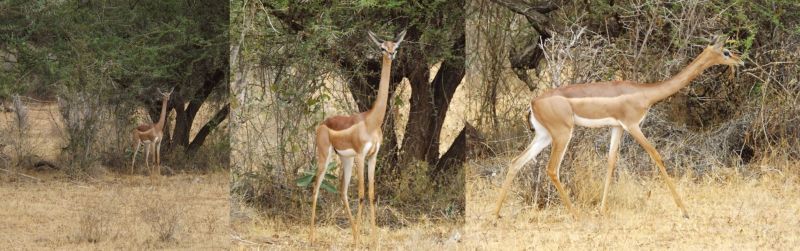
Gazelles. These are giraffe gazelles and not Thompson's gazelle that are commonly seen in zoos.

Do I even need to put a caption on these???

These were the hippos that we were about 30-40 feet away from. They look placid, but when they look right at you, it is enough to induce a puckering sensation ...

Hyenas. Very large and very scary. There were about a dozen in the pack.

These two male impala were "play" fighting as a way of establishing the pecking order in the herd.

Top two pix are impala and bottom two are water buck, a large antelope-like or deer-like like quadruped.

The lion we finally found. He really wanted to get away from the harassment of the other drivers.

Of course, the fellows with the colorful pajamas...zebra.
Well, we missed seeing much of Mombasa and we missed seeing much of Zanzibar, but we wouldn’t have traded it for anything!

I realize this post has been a long one and I appreciate your reading this far. We have a day at sea to recuperate, then a day in Mayotte followed by two days in Madagascar.

Stay tuned…